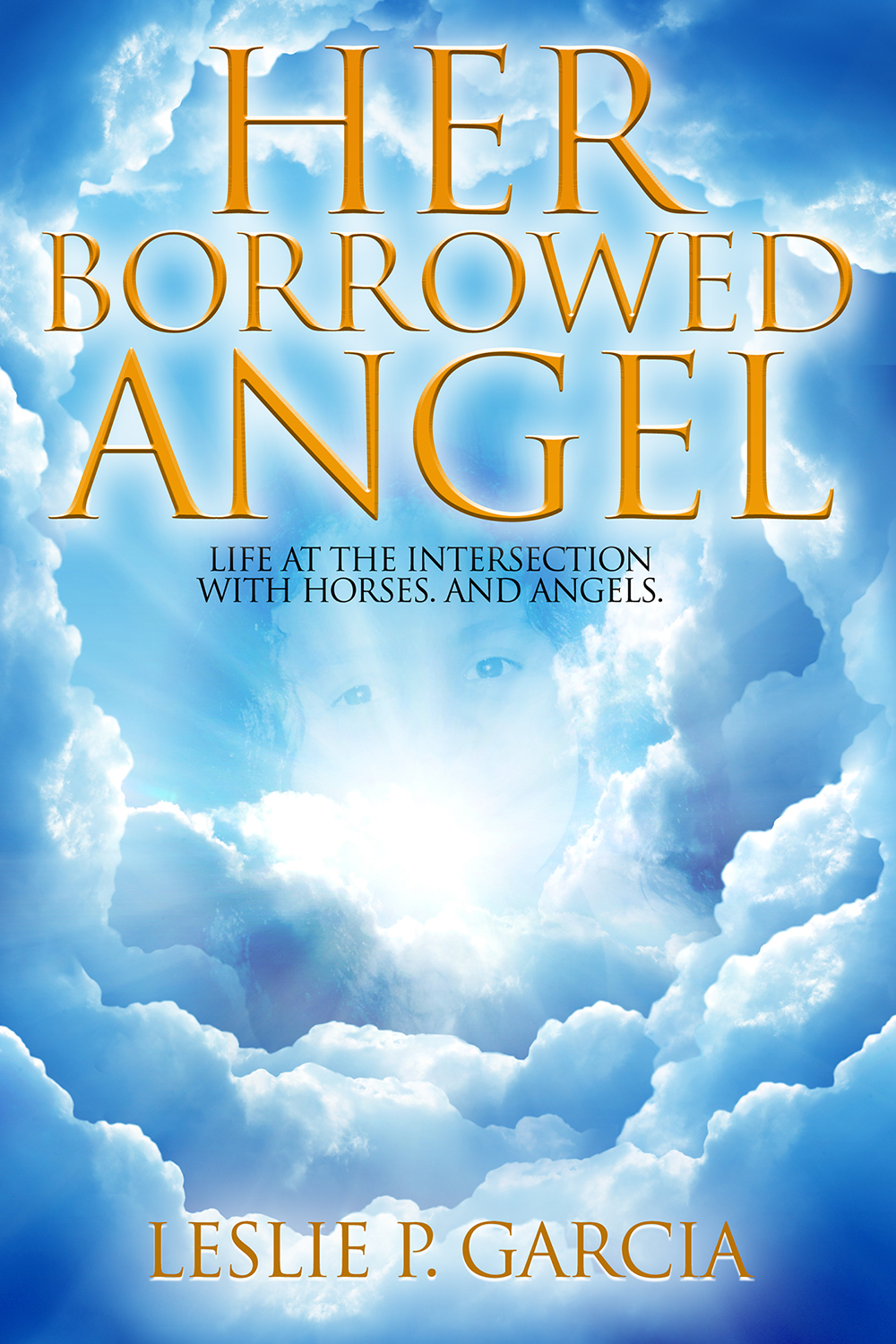
Forget the fact that Leslie P Garcia is my sister. Yes, I’m proud of her and I’ve always known she’s a brilliant writer. But her new book, “Her Borrowed Angel,” does not end on the last page—because the book simply won’t let the reader go.
The characters are so real and alive that the reader gets sucked into their lives and walks with them step-by-step, page after page. Her Borrowed Angel traces the life of book-smart Madeline Wharton Saldivar from her childhood in rural, deeply segregated Georgia to adulthood in northern Mexico and southern Texas.
Y2K, The Beatles, the Berlin Wall as it fell, Marilyn Monroe, Vietnam, men on the moon, Secretariat, Hank Aaron, Dr Martin Luther King, Jr.—we all live history. Sometimes we don’t see it happening around us. Her Borrowed Angel tells the story of Maddie Wharton Saldivar’s journey through life–life at the intersection with horses. And angels.
Maddie’s life, like all lives, plays out against the current events and changing social moods of the times. Deeply committed to family—and horses, or at least the idea of horses—Maddie struggles with the painful truths and impossible situations of abuse and dysfunction within her own small world. Buoyed by her sister Hattie’s infallible courage, as well as her own ability to catalog life into manageable increments she understands through her book learning and an ability to manufacture faith to lean on, Maddie survives her childhood—only to be disowned when she falls in love with Tavo, an undocumented worker at the dude ranch she flees to when she leaves home to help Hattie escape.
Over her lifetime, Maddie collects more angels than horses and confronts the harsh reality that her half-brother, Wally, might have been right when he warned her that book-smart wasn’t as useful as life-smart. Wife, mother, and teacher, Maddie’s life changes with the birth of her granddaughter—her borrowed angel.
You can’t blame the hedgehog. He is small with short legs. The gate separating him from the garden is lengthy. Little steps mean that it takes a long time to get around the gate to the opening into the garden. So he looks for a shortcut.
Not every shortcut is bad. Some are excellent. But this hedgehog’s shortcut failed due to hedgehog thinking—a malfunction common to humans. As the hedgehog journeyed down the alarmingly elongated fence it poked its nose into every piece of metal scrollwork looking for a wider gap so it could get through. However, the factory manufactured fence was uniform and no gap was wider. So the hedgehog took the shortcut anyway—and got stuck. (Not to worry—he was rescued.)
We humans do that in life. Take shortcuts doomed to failure. We want to harvest success in our life, but without the planting, weeding, watering, and nurturing required to guarantee it. We just want it to happen.
We want to skip the training process and get right to the rewarding qualification. We just want it to happen.
We want to lose weight—but not exercise. We want to maintain our perfect body size and shape and still eat everything we enjoy regardless of calories. Perfect health? We just want it to happen.
We want joy, but without giving up resentment, anger, and criticism. We just want it to happen.
We want our lives to be stellar, our trials short, our hardships easy. And when we disagree with something in the Bible, we want to change the words to ones we prefer and reject verses that tell us to endure hardships as a good soldier of Christ, or that remind us that, “We are His workmanship, created in Christ Jesus for good works, which God prepared beforehand that we should walk in them.” Ephesians 2:10.
While walking Savannah today I passed some teens engaged in a serious conversation. One said confidently to the other, “You become an adult when you turn eighteen.”
I nearly laughed. I just met someone who is not an adult yet in spite of having divorced after 27 years of marriage—which even with my sketchy math makes him more than eighteen. The divorce is not his fault.
The divorce is his girlfriend’s fault. She talked him into leaving his wife and then dumped him.
Being broke is not his fault. The divorce that is not his fault pushed him into gambling. He lost everything that remained after the divorce.
Having to walk everywhere on a bum knee is not his fault. Pressure from the gambling debt that is not his fault caused him to start drinking. He drove drunk and wiped out his car—which resulted in his aforementioned bum knee.
The bum knee isn’t his fault. The surgeon messed up the surgery. The bum knee is not his fault because the surgeon caused it. The injury from the drunk driving accident is not his fault because it was the result of the pressure from his gambling debt. The gambling debt is not his fault because it resulted from the divorce. The divorce is not his fault—in spite of his infidelity—because his girlfriend caused it.
Because he is broke—which isn’t his fault because he lost everything in the divorce that isn’t his fault and from the gambling that isn’t his fault—he lives in what he says is an uncomfortable house. That is the fault of the government for not engaging fully in socialism.
Wishing those kids in the skateboard park who believe they will magically become adult at age eighteen all the best.
It’s easy for me to thank God for everything He has given me—but things He has withheld from me?
When husband Alan retired after 35 years in the ministry he was offered a Church of Scotland rental house at a reduced rate. The first house we looked at was in Grantown-on-Spey—and we loved it. We told the property manager that we would take it…only to be informed that neighbors who had seen us looking at it had decided to purchase it.
God withheld living in Grantown-on-Spey from us and we never knew why until a few days ago when we made a six-hour trip there to visit friends. The area is beautiful, but after two days—we were becoming claustrophobic. Tall fir-tree-clad mountains held Grantown-on-Spey like the sides of a bowl. No, make that a mug. They were tall. Even worse—it was cold. We were miserable. The day we left, blowing snow covered everything. It was already an inch thick before we left. As we got closer to Dunoon, the snow ended. The temperature climbed—as much as it ever climbs in Scotland!
God has withheld other things from me. Singing. My sisters and I memorized songs from every musical and sang them loudly and joyously—to the horror of our parents who could sing on key and in tune. I still have no idea what keys have to do with singing. They unlock doors. As for singing—that’s easy. You just follow the voices and go up and down when they do. In my childhood mind, I sounded just like Julie Andrews, even the accent. But here in Scotland, folks don’t think I sound like Julie Andrews. They ask, “What part of the States are you from?” As for singing, people in different churches I’ve attended say, “Don’t worry if you can’t sing. The Bible says to make a joyful noise to the Lord.” Still, I’m never invited to lead praise or join the choir.
When I changed my major to drama at LaGrange College in Georgia, I wanted desperately to sing. Julie Andrews, right? I wanted the leading female role in the summer musicals we staged at Calloway Gardens. Instead of being awarded even a minor role or a place in the choir, however, I wound up painting backdrops for the productions. They trusted me with a paintbrush, but not with those illusive keys in the sky that I can’t see or hear.
What a blessing that God withheld singing from me. If I could sing, I wouldn’t write. I love singing so much that I would chase the will-o’-the-wisp of fame and fortune and knock down those doors that are locked by that key that I’ll never fathom. Instead, I have 31 published books and another one in progress.
And, instead, I’m a Christian. None of my drama department buddies were Christians. Since I thought I was an atheist back then, I fit right in. I would have continued a lifetime of travel on crowded, busy roads, too rushed and too frantic to hear God’s still small voice.
In Revelation 1:18 Jesus says, “I am He who lives, and was dead, and behold, I am alive forevermore. Amen. And I have the keys of Hades and of Death.”
Because Jesus lives, I can face tomorrow. Because He lives, all fear is gone. And because He lives—I am glad He withheld singing from me and allowed me to exchange those mystery keys for the keys to Heaven.
Usually my blogs are not about my books, although I do include a link to my books at the end. This time, it is about my newly released book—newly meaning today—Christian cozy mystery romance “Too Chili to Die.”
I often tell folks who will understand that God writes my books and I type them. Some folks don’t understand that, so I leave them to their own conclusions.
All I have ever wanted to do since I was nine years old is to write books. Just write. I am blessed by God that I can now do exactly that—after most of my life working two to three jobs at a time and using every stolen minute to write.
The Bible promises that “All things work together for good to those who love the Lord.” Those very jobs that kept me too busy to write now find their way into the background of my books. Like “Too Chili to Die”—working on a small local newspaper and covering events like chili cook-offs.
Too Chili to Die was fun to write. Hope readers will have as much fun reading it as I had writing it.
When the Lord gave me a children’s book story involving birds, I wrote it. It hasn’t been released yet for publication, but it is finished and waiting.
However, I wrote the story because of the Lord’s inspiration. I didn’t stop to think about birds—they were just the right vehicle to carry the story. I have seen small birds defend their nests from huge predators. I’ve been attacked by seagulls for getting too close to their nests. One of my heartwarming memories is the bird couple that built a nest in my garden center and became so attached to me that—thinking that I needed protection—they squared off against a hawk. When their babies left the nest for the first time, the babies hopped up into my lap for a visit before they flew away.
Most birds mate for life. One of my heartbreaking memories is getting home just in time to see a large raccoon lumber across our neighbor’s yard with blue feathers sticking out of both sides of its mouth and a California scrub jay desperately attacking the coon in an unsuccessful attempt to save its mate. The poor bird sat in the tree where his spouse lost her life for days emitting ear-shattering cries of anguish.
Still, I never realized the nobility of birds until this spring. Perhaps it’s the covid-slowed world that made me recognize it. Birds do. They simply do. They do what God has created them to do. They don’t wait for recognition from a music award ceremony or accolades from their church choir before they sing the songs the Creator of the universe gave them to sing…they just do.
Birds don’t wait for favorable or comfortable conditions to gather food. They do. They just do.
Birds don’t wait for good weather to collect material for their nests…they do. They just do. Birds simply do what God created them to. Without complaining. Without stopping. Without procrastination. Without recognition. Without complaining. And with the courage to send off a predator ten times their size.
The world would be a better place if humans practiced the nobility of birds. If they learned to do what God has created them to do. Without complaining. Without stopping. Without procrastination. Without recognition. Without complaining. And with courage, not fear.
“And what does the LORD require of you but to do justly, to love mercy, and to walk humbly with your God.” Micah 6:8
My world changed on Easter Sunday, 2021. My son’s dad died. We had been divorced for 43 years—but my world shifted when he died.
Most of my memories of life with Larry are miserable. Some are funny. A few are good.
The best of the good memories revolve around son Luke. Luke had a speech impediment when he first learned to talk. For a short time Larry rode and raced dirt bikes. He bought Luke a dirt bike when Luke was three. Luke’s bike was a red “Indian.” His dad rode a yellow “Yamaha.” Luke didn’t want his red bike; he wanted a yellow one like his dad, but he stammered over the word “Yamaha.” Larry told him, “When you learn to say, ‘Yamaha,’ I’ll buy you one.” Luke thought for a moment and replied, “Daddy, just get me a sellow one.”
When Larry and I started painting signs together, I painted the signs and he cleaned the brushes. It frustrated him to watch me paint when he couldn’t, so he used his VA benefits to take a commercial art course. He studied diligently and I went from sign painter to brush cleaner. He passed that diligence down to Luke; whatever Luke decided to do—he accomplished. He taught himself to play the trumpet, read music, play the piano, and fly an airplane.
Some of the memories are funny. We were stuck in the parking lot of a motor home repair shop in Kingman Arizona on our fourth anniversary while our motor home was getting fixed. We were headed for a gold dredging expedition on the North Fork of the American River in California. Larry said we should celebrate our anniversary with a meal out instead of our usual sandwiches for lunch. We went to a local resident and Larry purchased one meal. One. He had the hamburger, Luke had the fries, and I had the strawberry shortcake dessert even though I never liked any dessert that wasn’t chocolate. All three of us shared the soft drink that came with the meal.
I can’t sing. Really. I never believed I couldn’t sing until I was in college and our drama professor’s wife—who held a doctorate in music—tried to coach me so I could perform in the summer musicals at Calloway Gardens in Georgia. She finally said, “Stephanie, I don’t know why you can’t sing. I’ve never met anyone before who can’t sing. But—you really can’t sing.” When I first met Larry I thought I was an atheist and that it was my job to covert him. He dragged me to church with him every Sunday. He would elbow me in the side and demand, “sing.” It takes me years and hearing a song 20 or 30 times before I can even approach the tune. But with an elbow in my side, I would try to sing. A few minutes later—the elbow jab in the side again. “Shut up. You sound terrible.”
Larry was a perfectionist. Everything he did had to be perfect. He passed that trait down to Luke. They both cleaned everything and kept everything immaculately clean. I was a changeling in my own home. I drew my joy from writing—not cleaning. Perfection in anything never darkened my door. Larry kept the same pair of sunglasses for 20 years. I could go through three pairs in one year. He clipped and organized coupons. I was too impatient to use them.
There are the really bad memories, but I won’t share those. I’ll share the one that changed my life. Larry dragged me to church every Sunday even though I couldn’t sing, had never heard the songs before, and had no idea what the pastor was talking about. I went because Larry was more stubborn than I was. And because of that, I gave my life to Jesus. I was saved. I was born again, and my life was never the same after that.
When I heard that Larry was dying of cancer in a VA Hospital I tried to call him and thank him for dragging to church with him. He never woke up enough to take a phone call, but two of the nurses passed my message along. I hope it gave him some comfort and peace.
My world changed this Easter Sunday when Larry left this earth. But it changed most of all on that very first Easter when Jesus died on the cross, was buried, and rose again on Easter Sunday. Because He lives, I will live again when this body dies. Just like Larry. Just like Luke who preceded both of us in death on November 17, 2013, in a plane crash, at age 37.
I owe my place in eternity to a man who could play a guitar, sing, fix anything with a pocket knife, and was more stubborn than me.
Just got an invitation to purchase a book on “Brain Training Your Dog.” That’s funny. My dog doesn’t need brain training—I do.
Every time I take Savannah on a walk Alan always says, “Remember; you are in control.” That’s also funny. Savannah’s brain is fully trained for walks—and so is mine. She leads, I follow. We go in the direction she chooses. We go the distance she chooses. We stop and visit all the friendly dogs and people who are her friends. We stay away from the trio of aggressive pit bulls on the corner. We don’t chase the foxes in the field behind the cottages, or cats, or hedgehogs—but we do chase black birds and blackbirds. I don’t know why. You’d have to ask Savannah.
Savannah never forgets where she leaves anything, nor does she forget where things belong. She is a grueling taskmaster/housekeeper. Everything must be where it belongs at all times and at no time is anything to be on the floor that doesn’t belong there. Except her toys, of course. They apparently belong there.
On walks Savannah picks up lost gloves and deflated soccer balls and carries them until she gets tired. But she never forgets where she left them. She picks them up again on the next walk. I used to attempt to take gloves away from her and put them up where someone would find them, but humans never returned to claim them. Savannah did. And since she carries things to the end of her walk, then brings them back—it really doesn’t matter. They eventually get back to where they started. Me? I can put down a granola bar and not find it again for a week.
I walk through life as if I’m in a bubble. For a writer, I’m not very observant. Savannah notices everything. She spies on the neighbors and looks over fences to see what’s going on. She detects new labels on a rubbish bins and things that have been moved across yards from one side to the other. I’d have to trip over the relocated objects before I noticed. She would be great in a neighborhood watch program if only she could talk.
Some clever person noticed that dog spelled backward is God. Only God is God, but I am thankful that He made dogs.
An old man worked hard ferrying passengers across a wide deep river in his little boat. One day as he was getting the boat ready for his next trip across the water he spotted a muddy lamp under a discarded tire. He pulled the lamp out from under the tire and stuck it in his boat. He took his passengers across the river. On the return trip he pulled the lamp out and dunked it into the water to clean it. A genie swirled out of the spout and told the man he had three wishes.
“My arm hurts,” the old man said. “Heal my arm.”
The genie did.
“I want to be young again,” the old man said. “Make me young again.”
The genie did.
“I want to be rich,” the old man said. “Fill up this boat with gold.”
The genie did.
The boat sank and the man died.
From time to time we all wish for things that have been withheld from us. Perhaps a lovely house overlooking the sea. We envision life in a beautiful home overlooking scenic glory as blissful…but we don’t know what goes on inside the walls.
Perhaps an exotic vacation to foreign lands (for me, a warm foreign land). We imagine the joy and think of the fun we would have—but we don’t see the stress; the sickness caused by bad water; the theft from the hotel room, the passport or stolen bank card.
Hebrews 13:5 says, “Let your conduct be without covetousness; be content with such things as you have.”
For years, I’ve wanted my hair to grow longer. Every time it got to a decent length, the ends would need to be trimmed and it would be shorter again. With the lockdown, there are no beauty salons open and I’m scandalously bad at cutting or trimming hair. So my hair has finally grown long. And I can’t reach the ends in back when I brush it. It is so fine that it won’t stay in any kind of fastener and it gets hopelessly tangled in the wind. It blows across my eyes so I can’t see. It gets in my mouth. It gets caught under me at night. And…
We all want that boatload of gold. We forget that every physical thing we own on this earth can sink, be stolen, get old, or break. We are pilgrims passing through this earth on the way to Heaven where boats don’t sink.
There is one place along our street where the shadows across the sidewalk look so real that—even knowing they are shadows—my feet pause. They look like metal bars across the concrete.
Walking rough collie Savannah at night presents me with an intimate introduction to neighborhood shadows. That bulky man at the corner watching the street and everything that passes—nothing more than two signs a short distance apart that meld together into a menacing form. The guy who is always at work at the back of a parked trailer—actually a large plastic chute from scaffolding and a black trash bag at the end that blows in the wind. And that big dog that I expect to bark at us—really an overturned trash bin next to an empty planter.
Under the covering of darkness with street lights punching holes in the night—neighborhood shadows look real. Some look intimidating. Some look menacing. Some—like the hedgehog that never moves—look interesting. But whatever the size and shape of the shadows, one fact remains; they are not real. No matter how intimidating, no shadow will roar into life and shout. No matter how menacing, no shadow will attack. No matter how interesting, no shadow will lead to an intriguing adventure like Alice falling down the rabbit hole. Shadows are illusions. They. Are. Not. Real.
Shadows fascinate me. They play a predominate role in my book “Fear of Shadows,” and the first three books I wrote all have the word “shadows” in the titles. Shadows are deceptive. Some folks go through life fleeing from shadow to shadow.
If we remember that this earth is not our home and we are merely pilgrims passing through and if we do not fear death—shadows lose their ability to haunt us.
“Yea, though I walk through the valley of the shadow of death, I will fear no evil,” Psalm 23 declares.






 Stephanie Parker McKean