Keep on Nesting

When I was a kid in school, the ultimate insult was to call someone a “bird brain.” Thankfully, I made it through school before the “F” word hit. I was in junior high school before I ever heard it. I went home and asked my mother what it meant.

Birds are admirable. When my son Luke and I lived in the Great Basin Desert in Nevada, we rescued a baby raven. Luke named it “Rap.” Rap followed Luke and our dog when Luke rode his bicycle or 4-wheeler. Rap chased strangers away from our house. We lived on an alfalfa farm. Rap flew into the barn everyday at noon and walked up and down the long table accepting offerings from farm workers who met to eat their lunches. When Luke’s stepfather worked on the truck, Rap brought him tools—but we soon learned that if he wasn’t watched—Rap would fly off with any tool he fancied. Also in the desert, Luke and I watched ravens drop rocks on marauders to protect their nests.

Striated herons in Asia catch fish by floating bait to lure them close enough to strike. The woodpecker finch from the Galapagos Island extracts insect larvae from tree crevices with a thorn. Egyptian vultures use stones to crack large eggs. Here in Dunoon, Scotland, seagulls drop shells down onto pavement to crack them open so they can extract the residents. Breakfast served.

Jesus said not even a sparrow drops to the ground without God knowing and caring. In Jesus’ day, birds were used as currency.

Old miners on the edge of the desert in Unionville, Nevada, keep magpies as pets and teach them to talk. My grandmother had a parrot who watched TV. The first thing he ever said—mimicking a commercial that was popular at the time—was, “I can’t believe I ate the whole thing.” After that—he was unstoppable. When anything upset him, he would say “poor Popeye,” in a pathetic sounding voice. In the mornings he would call Grandmother and say, “Maybelle, coffee, toast. Popeye wants breakfast.”

All these things are indeed admirable—but none is the reason I admire birds and their intelligence so much. What I most love about birds is their understanding of and deep dependence on God’s will in their lives. Especially in nesting. At the right time each spring, birds nest. Gales can be alive with 80 mph winds, late snowfall can blanket the land, trees can remain bare-branched, flowers heads can linger under the soil—yet the birds nest. They make no excuse for hardship, inclement weather, or turbulence. God’s wisdom tells them it is time to nest…so they nest…regardless of adversity.

Sadly, some people quit nesting in the loving arms of Jesus as soon as trouble trips into their lives. They rehearse all the excuses: how can I believe in God when He let something bad happen to me? I’m living a good life. Why doesn’t God keep all these troubles away from me? I had more friends before I became a Christian. Following Jesus is too hard.

We live in a fallen world. That’s not God’s fault. He never planned for the world to be flawed. Sin entered into the world with Adam and Eve. Before sin entered, there was no death, no violence, no anger—the Garden of Eden was perfect. Animals and people were friends and God walked in the garden with His creation. But when sin slipped into the perfect world…blight replaced perfection.

Birds don’t argue politics. They don’t assume their way is the only way. They fly above contention and discord…and they keep on nesting.

Jesus said, “Do not worry…Look at the birds of the air, for they neither sow nor reap nor gather into barns; yet your heavenly Father feeds them Are you not of more value than they?” Matthew 6:26.

Jesus has the credentials to declare value. He lifted up His arms and died on the cross to deliver us from our sins, and He rose again on the third day to live forever. With us if we nest with Him.

Amazon.com: Stephanie Parker McKean: books, biography, latest update
Little Heroes

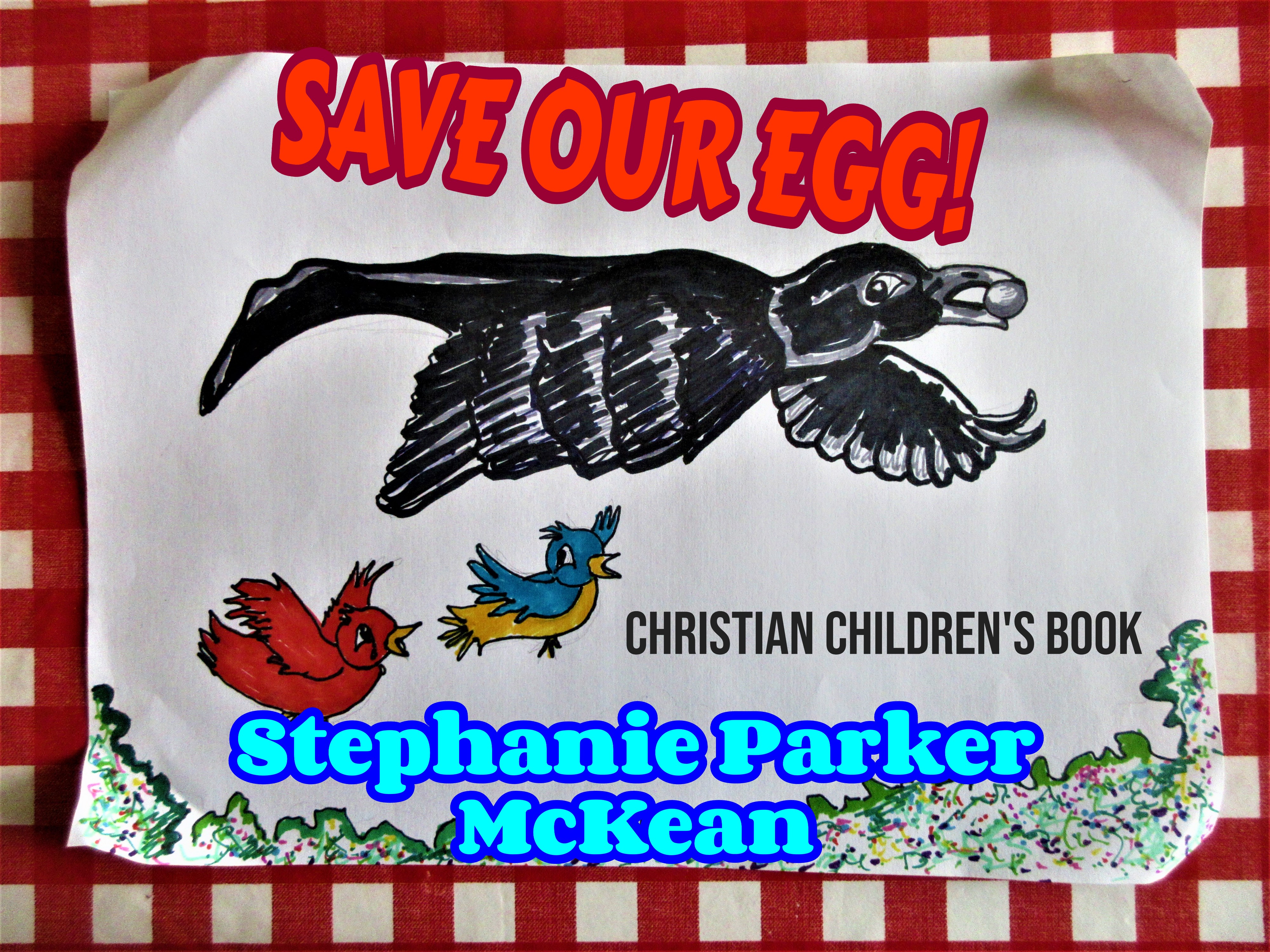
When I was five, I found an injured bird, caught it, and took it home. It wasn’t injured. I had unknowingly approached its nest too closely. It pretended to have a broken wing to lead me away. It offered its life in place of its young. That memory inspired me to write my children’s book, “Save Our Egg.”

BA…meaning Before Arthritis, I used to run. I liked to run around the fenced track at the school. There was no hard surface and the grass made running difficult, but because it was a mile—it was easy to keep track of distance. One day—running it proved hazardous. Neighborhood seagulls were teaching their babies to fly and had positioned them in the middle of the field. They considered me a threat. Their angry squawks and repeated dive bombing sent me back to the pavement.

When son Luke was eleven, we rescued and raised a baby raven. Rap followed Luke everywhere—even when he was riding his bike. Unlike our collie puppy who liked everyone, Rap was a guard dog. He loved Luke’s best friend, but when people he didn’t know entered our driveway—Rap attacked. He never bothered neighborhood kids in their own yards—just in “his” yard. When the ranchers took a break for lunch in the barn, Rap joined them, walking up and down the long table to accept whatever tidbits they were willing to share.

Recently, a pigeon knocked on our glass door at the back of the house. I opened the door and the bird walked in and settled under one of the kitchen chairs. It was raining, so I gave the bird some seed and water and let it spend the night. The next morning, the pigeon began following me around the house and I put it back outside. Birds are intelligent. Calling someone a “bird brain” is actually a compliment.

Jesus said, “Look at the birds of the air, for they neither sow nor reap nor gather into barns; yet your heavenly Father feeds them.” Matthew 6:26. Jesus also said that not even one sparrow falls to the ground apart from the Father’s will, and adds, “Do not fear therefore; you are of more value than many sparrows.” Matthew 10:31.

Birds are little heroes.

The Nobility of Birds

When the Lord gave me a children’s book story involving birds, I wrote it. It hasn’t been released yet for publication, but it is finished and waiting.

However, I wrote the story because of the Lord’s inspiration. I didn’t stop to think about birds—they were just the right vehicle to carry the story. I have seen small birds defend their nests from huge predators. I’ve been attacked by seagulls for getting too close to their nests. One of my heartwarming memories is the bird couple that built a nest in my garden center and became so attached to me that—thinking that I needed protection—they squared off against a hawk. When their babies left the nest for the first time, the babies hopped up into my lap for a visit before they flew away.

Most birds mate for life. One of my heartbreaking memories is getting home just in time to see a large raccoon lumber across our neighbor’s yard with blue feathers sticking out of both sides of its mouth and a California scrub jay desperately attacking the coon in an unsuccessful attempt to save its mate. The poor bird sat in the tree where his spouse lost her life for days emitting ear-shattering cries of anguish.

Still, I never realized the nobility of birds until this spring. Perhaps it’s the covid-slowed world that made me recognize it. Birds do. They simply do. They do what God has created them to do. They don’t wait for recognition from a music award ceremony or accolades from their church choir before they sing the songs the Creator of the universe gave them to sing…they just do.

Birds don’t wait for favorable or comfortable conditions to gather food. They do. They just do.

Birds don’t wait for good weather to collect material for their nests…they do. They just do. Birds simply do what God created them to. Without complaining. Without stopping. Without procrastination. Without recognition. Without complaining. And with the courage to send off a predator ten times their size.

The world would be a better place if humans practiced the nobility of birds. If they learned to do what God has created them to do. Without complaining. Without stopping. Without procrastination. Without recognition. Without complaining. And with courage, not fear.

“And what does the LORD require of you but to do justly, to love mercy, and to walk humbly with your God.” Micah 6:8

Amazon.com: Stephanie Parker McKean: Books, Biography, Blog, Audiobooks, Kindle

Girls, Take it From the Birds

male bird 3

When God created birds, He gave male birds bright, colorful feathers to attract females. Girl birds don’t work to attract boy birds; boy birds work to attract girl birds.

We’ve got it all wrong today. Females wear skimpy to non-existent clothing, color their hair, pierce their bodies, and paint their faces to attract males. Listen up, women: we should learn from the birds.

I saw a young girl yesterday wearing such exaggerated makeup that she looked like a cat. Her eye shadow was so thick and dark that it hid her eyebrows. She wore a short skirt that barely covered her underwear, a top cut so low that her boobs almost popped out, and the expression of a lost puppy on the side of the road.

Women need to reverse the media hype about attracting men and make men work for it. Take it from the birds. Today’s expectations about how women should look, and the pressure for women to hunt down men as if they were prey and capture them is a recipe for mental illness. It makes women feel unattractive, unloved, and unappreciated because they can never live up to the unrealistic expectations. We should learn from the birds.

In Jesus’ time, when a man asked a woman to marry her, he went out and built her a house, then collected his bride. He worked for it and she felt respected, loved and protected. When Abraham wanted a wife for his son Isaac, he sent camels loaded with treasure to the young woman and her family. Isaac loved his wife Rebekah and she felt loved, cherished and appreciated. Isaac worked for it.

The Bible upholds the best image for a woman to have of herself: Charm is deceitful and beauty is passing, but a woman who fears the LORD shall be praised. (Proverbs 31:30) Time cannot ruin beauty that is on the inside, nor does it require plucking, painting, pricking, or pruning to perfect.

We should learn from the birds.

peacock 2