A woman who clawed her way to fame and fortune by becoming ‘the human Barbie Doll’ spent $42,000 on 27 plastic surgeries. She is dead at 31.
Global basketball icon Kobe Bryant died in a helicopter crash in 2020, at age 41.
TV icon Steve Irwin died in 2006, at 44, after he was stung by a stingray.
Princess Diana died in 1997, at age 36, in a vehicle crash.
Actor River Phoenix died in 1993, of a heroin overdose. He was 23.
Musician Kurt Cobain died in 1994, from a self-inflicted gunshot wound. He was 27.
They chased tomorrow. Tomorrow came. Youth, beauty, fame, riches—nothing kept them from death.
Nor will wisdom, education, and learning defeat death when tomorrow comes.
Karl Patterson Schmidt, 67, was a world renowned herpetologist. He had handled thousands of snakes over forty years and traveled around the world presenting lectures and identifying snakes. He excelled in wisdom, education and learning.
Schmidt was contacted in 1957, to identify a small, colorful snake that no one else could identify. When he saw it, Schmidt immediately knew what it was; a juvenile boomslang, deadly in adulthood but usually harmless as a juvenile. The snake’s fangs were located in the rear of its mouth and its mouth couldn’t open wide enough to inflict a bite on a person—so Schmidt calmly explained as he handled the venomous reptile. The snake bit Schmidt. Twenty-four hours later—he was dead.
The popular cliché “tomorrow never comes” is false. Tomorrow comes. So does death.
Nothing we can accomplish in this life on earth can stop tomorrow. Beauty will not paralyze it. Money will not purchase relief from it. Fame will not faze it. Knowledge, wisdom, and education will not outsmart it.
Our victory over tomorrow is to outlast it by living for God so that when tomorrow comes it brings the sweet victory and relief of heaven with it.
“And this is the testimony; that God has given us eternal life, and that life is in His Son Jesus. He who has Jesus has life; he who does not have the Son of God does not have life.” 1 John 5:11.
As a three-year-old, I made an amazing discovery. The old, worn, torn, smelly couch on the debris pile next to my house hid the most delicious, desirable treats; brightly colored orbs with chocolate inside. I didn’t know what chocolate was—I just knew I loved it. I didn’t know the name of the candies—M&Ms.
An adult would have been scandalized to see me digging the candy out of a couch on a trash pile and eating it. They would have screamed words at me that I wouldn’t have understood—nasty, germs, bacteria. To me the candies were delicious and delightful. A matter of perspective.
I worked at a Christian preschool with a woman named Norma. Norma was just over six-feet tall and weighed close to four-hundred pounds. Her daughter, 12, nearly hit the six-foot mark and weighed close to two-hundred pounds. Norma drove a little Ford Courier pickup truck. One day Norma pulled into the parking lot and the tire on the driver’s side exploded. Instead of being embarrassed by his severely overweight wife and daughter, Norma’s husband laughed gleefully. “Look at that!” he exclaimed. “My wife and my daughter just popped a tire.” A matter of perspective.
When son Luke was eleven and we lived in the Nevada desert, I sat on the kitchen floor crying on Thanksgiving Day. People all around the country would celebrate the special holiday with turkey and all the trimmings. Thanksgiving was the only meal that Luke—a picky eater—really liked. He loved it. But as a single parent—I had no money for a Thanksgiving meal. We would have peanut butter and jelly sandwiches.
There was a knock on the door. Our next door neighbor, a woman in her eighties, invited us to share Thanksgiving Dinner with her family. I was ecstatic. So was Luke.
Luke and I helped Mrs. Merca set the table and put the finishing touches on the feast. Enter her family; parents swigging cans of beer and toting 12-packs because Mrs. Merca didn’t drink; their son and daughter with wildly colored hair and metal junk sticking out of unrealistic places. This was nearly 40 years ago. I had never seen “body jewelry” before. The boy had a row of safety pins in both ear lobes. Luke couldn’t quit staring at him.
However, it wasn’t the outward appearance of Mrs. Merca’s family that was so shattering—it was their actions and attitudes. They barely bothered to greet their mother/grandmother. They piled onto the couch and turned on a football game. No effort or offer to help the 85-year-old carry heavy dishes to the table. And when the food was on the table, they converged on it like starving wildlife—no prayer, no mention of things for which to be thankful. They filled their plates, and plopped back down on the couch to watch the ballgame leaving Mrs. Merca at the table with Luke and me.
When we got home after helping clean up after the meal, Luke was sad and pensive. I asked what was wrong. “Well, Mom. It was nice for Mrs. Merca to invite us to Thanksgiving and everything, but I wish we had stayed home and had our peanut butter and jelly sandwiches so we could have prayed and thanked God.” A matter of perspective.
“Make a joyful shout to the LORD…Serve the LORD with gladness; come before His presence with singing. Know that the LORD, He is God; it is He who made us, and not we ourselves; we are His people and the sheep of His pasture. Come into His gates with thanksgiving, and into His courts with praise.” Psalm 100.
Today I watched what seemed to be an old, tired fly climbing on a fence and I wondered—do flies know when they are about to die?
There is nothing wrong with wondering about things. When an apple dropped on Sir Isaac’s head he wondered—and discovered the law of gravity.
When Thomas Edison saw lightning strike the ground he wondered—and discovered electricity.
When Sir Alexander Fleming noticed colonies of staphylococcus bacteria in his Petri dishes avoiding mold in 1928, he wondered—and discovered penicillin.
When a Swiss engineer returned from a hike in the Alps in 1941, and wondered about the burdock burrs sticking to his clothes—he invented Velcro.
When Percy Spencer was working on a radar-related project in 1946, and noticed a chocolate bar in his pocked melted more quickly than expected—he wondered and invented the microwave.
Wondering can be beneficial…but wondering if flies know when they are about to die? Who wonders about something as inane as that? My son Luke would understand if he was still here with me. He taught me to see the wind.
Christina Rossetti, who was born in 1830, wrote the poem, Who has seen the wind?
Who has seen the wind?
Neither I nor you:
But when the leaves hang trembling,
The wind is passing through.
I read this poem to Luke when he was a child. I read scientific facts and explanations to him as to why it was impossible to see the wind. But Luke continued to insist that he could see the wind. And one day when we were out in the desert Luke taught me to see the wind. He was right. So the son of my heart would understand his mother wondering if flies know when they are about to die.
Not even Luke, however, would be able to tell me how my wondering about flies would benefit life on this earth.
So, while I don’t know if flies know when they are about to die, I do know that our Lord God is a Mighty God who does wonders. “You shall praise the name of the LORD your God who has dealt wondrously with you…I am the LORD your God and there is no other.” Joel 2:27.
The clerk says confidently, “I’ll be back in two seconds.” Fifteen minutes later, as the minute hand on your watch advances and the clerk doesn’t, ‘tis a puzzlement. Did the clerk drop from heaven and is, therefore, operating on heaven’s time line?
“Do not forget this one thing, that with the Lord one day is as a thousand years, and a thousand years as one day.” 2 Peter 3:8.
‘Twas a puzzlement about my father who boasted about his 140 IQ, but did stupid things. Like letting his children throw chicken bones to wild alligators even knowing that gators can run at speeds of 35 mph…and children can’t. There were seven of us. Perhaps that explains it. We were dispensable.
Like engaging his 14-year-old daughter—me—to burn down the house for the insurance money when he got into deep financial mire from spending his money on boats that would never touch water; a sports car he couldn’t afford to fill with gas, and a plane that didn’t fly, while his children went to school with worn-out shoes held together with rubber bands, and hand-me-down clothes with holes in them. Perhaps he looked into the future with that 140 IQ and foresaw today’s fashions.
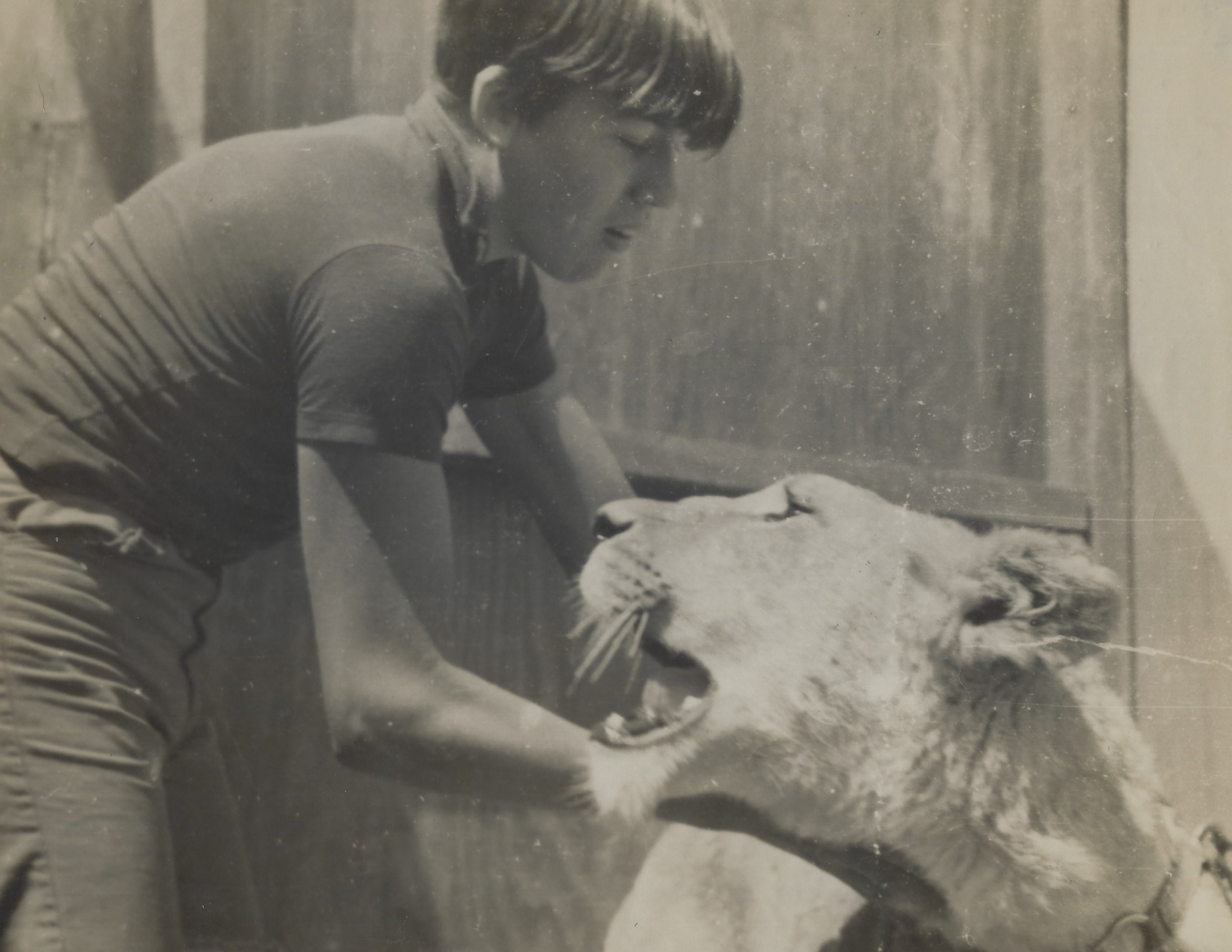
And the lion. Bringing an African lion home as a house pet. True, it was only 150 pounds when it first came—not much heavier than our Great Dane dogs, but Ebenezer quickly grew to 450 pounds and tore apart his expanded metal cage to escape—repeatedly. When Ebenezer escaped, only my oldest brother Gregory (the first one of us to leave this earth for Jesus’ arms) and our local veterinarian could recapture him and get him back into his cage before he brought down one of the horses or terrified neighbors.
And the horses. No one could tell my father anything—because he already knew everything. His 140 IQ, as he reminded everyone. Even as a twelve-year-old, my sister Leslie Garcia had probably read every book that had ever been written about horses. She knew our poor horses lacked proper nutrition and veterinary care, but when she tried to tell our father and he thought she was arguing with him—he jerked her out of bed, shoved her down on the floor and kicked her until she bled.
‘Twas a puzzlement at the time—but I understand now. My father was an atheist. He forbid us to read a Bible or Christian books, to go to Vacation Bible School at the nearby Baptist Church, or to go to any church anywhere. We were also forbidden to sing hymns or Christian songs.
The 140 IQ that my father was so proud of was wasted because there was no wisdom to back it up. “The fear of the LORD is the beginning of wisdom.” Psalm 111:10.
My father did not fear God. He did not believe in God. He wanted to be God. He thought his 140 IQ—an intelligence that God gave him—qualified him as God. “The fool has said in his heart, there is no God.” They are corrupt. They have done abominable works. There is none who does good. Psalm 14:1
There is hope for all of us—even those of us with what the world considers lower IQs. “If any of you lacks wisdom, let him ask of God, who gives to all liberally and without reproach, and it will be given to him. James 1:5.
However…I still haven’t figured out about that vanishing clerk who was coming back in “two seconds.”
Because I used to consider myself an artist—before I realized that I was a “copyist,” not an artist—and because I’ve spent most of my adult life painting signs, I have a highly developed sense of colors.
For years I’ve been flummoxed by folks who call orange “yellow” or green “blue.” And how can anyone survey rows of lavender flowers and call them “blue,” instead of purple? Fortunately, I am learning. I am slowly realizing that I have no right to assign to others the task of seeing colors the same way I do. God created them. He created their eyes. Their cones—the part of our eyes that sees color—may be different than mine. My task is to allow them their sight.
With my husband hospitalized, my brother-in-law and I have been spending a large amount of time together. No matter what our conversation, he responds, “Oh, I see.” But clearly—he doesn’t. At least, he doesn’t see the way I see because he misses the point I was attempting to make entirely and draws a totally different conclusion. At first it irritated me because I was endeavoring to explain things so clearly and concisely, and he would respond, “Oh, I see,” and trot out an entirely different scenario.
I am gradually learning to allow him his sight. His life experiences have colored his understanding a different color than my life experiences have colored my understanding.
Some things are without question right and some things are without question wrong. These things are worth fighting for or against and upholding as a standard. God wants that. But God has no interest in which hue on the color chart becomes orange instead of yellow, or green instead of blue. He created all colors.
God created us and gave us free choice. If God allows us to experience life through the color chart that He assigns for us—why should we expect others to walk in our chart instead of the one that God destined for them?
Our task is to allow others their sight.
“For we walk by faith, not by sight.” 2 Corinthians 5:7
I don’t think a single day passes that I don’t say at some point in the day, “I am blessed.”
When I share a Facebook post of someone rescuing a skunk and adding it to their family, I say to myself, “I am blessed that we had a skunk when we were kids.”
When a picture of Scotland’s Loch Ness pops up on the TV along with a report about searching for the Loch Ness Monster, I say to myself, “I am blessed that I’ve been to Loch Ness and searched for Nessie.”
When I walk Savannah and see a lovely flower, I say to myself, “I am blessed to have seen this flower today.”
God has poured out blessings into my life. He began pouring out blessings into my life even before I knew Him. He put me in places and engineered experiences in my life that infuse themselves into the cozy mysteries I write.
I am blessed to have lived in Georgia, Alabama, Texas, Nevada, California, Idaho, and Scotland. I have walked to the end a Scottish road to take photos of leaping dolphins. I have explored the Great Basin Desert in Nevada and watched a mountain lion melt off a rock along the trail. I have panned and prospected for gold in California and Nevada. I know how to pan for gold in rivers and how to operate a wet washer and a dry washer on land.
I am blessed to have poured concrete slabs, built rock flowerbeds, rocked the sides of a house and garden center—and been hired as a landscaper for other jobs. I am blessed that I learned to touch type. I am blessed to have worked as a staff writer for newspapers and have met extraordinary and interesting people—including the governor of Texas who later became President.
I am blessed to have caught and released snakes and horned toads and rescued wildlife. When I see news about a wild raven that has adopted a person—I remember my son Luke rescuing and raising ravens in the Nevada desert including Rap who lived in our house with us, a cat and a dog, and integrated himself into the family. I remember Rap flying along behind Luke when Luke rode his bicycle or four-wheeler, riding on our shoulders when we took a walk, and chasing away any perceived “enemy” threat approaching our house. I am blessed.
I am blessed to have watched a Gila monster, picked olives, walked through citrus fruit orchards, learned to drive in snow, been caught in a tumbleweed circus in the desert, watched porcupines and coyotes trail through my yard, explored ghost towns, ridden horses, had a fox and a raccoon as pets, smelled out possums in the Georgia woods, and to have been raised with completely awesome sisters and brothers: Leslie, Gregory, Vicky, Jerry, Jeff, and Chris.
I am blessed that my grandmother taught me to make hot chocolate and yeast rolls from scratch and how to make gravy.
I am blessed that I survived the bad, painful, and horrific events in my life: constant rape and sexual abuse as a child; a horse kick in the face; getting impregnated twice by the abuser and having two backwoods abortions—nearly bleeding to death followed by hospitalization; an African lion bite on my stomach; a venomous water moccasin bite on my hand and a trip to the hospital in a taxi from another town because Grandmother was having a feud with the local taxi company; marrying a mentally unstable alcoholic to get away from home; contemplating suicide following the unfaithfulness of said alcoholic husband; nursing terminally ill husband number two through cancer and staying at his side until he left for heaven; back surgery, knee surgery, hip surgery followed by an infection which kept me in the hospital for three months and caused diabetes from the constant antibiotic drip; being the sole caregiver of husband number three who has cancer and Parkinson’s Disease…and the most painful experience of all, losing son Luke in a plane crash when he was only 49. I am blessed to have survived, to be able to encourage others, and to be able to dip into life experiences and splash them into the 48 Christian cozy mysteries which I’ve written. (Only 46 available at the moment.)
I am blessed to have lived under a bridge in the back of a pickup truck. I am blessed to have lived in an open-ended garden center with no running water and to have been gifted hay bales to stack up in the winter to cut off the wind and block the cold. I am blessed to have watched baby birds hatch from overhead hanging baskets in the garden center and have them flutter into my lap while I sat quietly in a chair.
I am blessed. Every flower that I see, every bird that I hear, every new place I visit makes me realize how blessed I am.
The greatest sorrow of my life: losing Luke and living so far away from granddaughter Dulcinea.
The greatest blessing of my life: discovering that God is real and that He loves me.
“You will keep him in perfect peace, whose mind is stayed on You.” Isaiah 26:2
When I was a kid in school, the ultimate insult was to call someone a “bird brain.” Thankfully, I made it through school before the “F” word hit. I was in junior high school before I ever heard it. I went home and asked my mother what it meant.
Birds are admirable. When my son Luke and I lived in the Great Basin Desert in Nevada, we rescued a baby raven. Luke named it “Rap.” Rap followed Luke and our dog when Luke rode his bicycle or 4-wheeler. Rap chased strangers away from our house. We lived on an alfalfa farm. Rap flew into the barn everyday at noon and walked up and down the long table accepting offerings from farm workers who met to eat their lunches. When Luke’s stepfather worked on the truck, Rap brought him tools—but we soon learned that if he wasn’t watched—Rap would fly off with any tool he fancied. Also in the desert, Luke and I watched ravens drop rocks on marauders to protect their nests.
Striated herons in Asia catch fish by floating bait to lure them close enough to strike. The woodpecker finch from the Galapagos Island extracts insect larvae from tree crevices with a thorn. Egyptian vultures use stones to crack large eggs. Here in Dunoon, Scotland, seagulls drop shells down onto pavement to crack them open so they can extract the residents. Breakfast served.
Jesus said not even a sparrow drops to the ground without God knowing and caring. In Jesus’ day, birds were used as currency.
Old miners on the edge of the desert in Unionville, Nevada, keep magpies as pets and teach them to talk. My grandmother had a parrot who watched TV. The first thing he ever said—mimicking a commercial that was popular at the time—was, “I can’t believe I ate the whole thing.” After that—he was unstoppable. When anything upset him, he would say “poor Popeye,” in a pathetic sounding voice. In the mornings he would call Grandmother and say, “Maybelle, coffee, toast. Popeye wants breakfast.”
All these things are indeed admirable—but none is the reason I admire birds and their intelligence so much. What I most love about birds is their understanding of and deep dependence on God’s will in their lives. Especially in nesting. At the right time each spring, birds nest. Gales can be alive with 80 mph winds, late snowfall can blanket the land, trees can remain bare-branched, flowers heads can linger under the soil—yet the birds nest. They make no excuse for hardship, inclement weather, or turbulence. God’s wisdom tells them it is time to nest…so they nest…regardless of adversity.
Sadly, some people quit nesting in the loving arms of Jesus as soon as trouble trips into their lives. They rehearse all the excuses: how can I believe in God when He let something bad happen to me? I’m living a good life. Why doesn’t God keep all these troubles away from me? I had more friends before I became a Christian. Following Jesus is too hard.
We live in a fallen world. That’s not God’s fault. He never planned for the world to be flawed. Sin entered into the world with Adam and Eve. Before sin entered, there was no death, no violence, no anger—the Garden of Eden was perfect. Animals and people were friends and God walked in the garden with His creation. But when sin slipped into the perfect world…blight replaced perfection.
Birds don’t argue politics. They don’t assume their way is the only way. They fly above contention and discord…and they keep on nesting.
Jesus said, “Do not worry…Look at the birds of the air, for they neither sow nor reap nor gather into barns; yet your heavenly Father feeds them Are you not of more value than they?” Matthew 6:26.
Jesus has the credentials to declare value. He lifted up His arms and died on the cross to deliver us from our sins, and He rose again on the third day to live forever. With us if we nest with Him.
Because pushing my husband in a wheelchair and pulling him around the house in his potty chair since he can’t walk has increased the size of my knuckles, I can no longer wear my wedding ring. My husband lost so much weight over the five months he spent in the hospital that his wedding ring was too large—and he lost it. So neither of us wear our wedding rings—but the missing wedding rings do not mean that we are not still married. The rings were merely a symbol of our marriage. A label.
Changing labels does not change reality.
William Shakespeare perhaps said it best in 1595 when he wrote ‘Romeo and Juliet.’ “A rose by any other name would smell as sweet.” Changing the name of the flower does not change the rose.
Geologists often abandon BC—Before Christ, and AD—After Christ’s Death, for BP—Before the Present. Astrologists often replace BC and AD with CE for Common Era and BCE for Before Common Era. These new labels do not negate the fact that we celebrate Christmas as the time that Jesus Christ, God’s own Son, came to earth to live as a man and experience everything we experience so He could understand our trials and temptations and deliver us from them, and so that we could see our God in human flesh. It does not negate the fact that more than 2,000 years ago, Jesus Christ died on a cross and was sealed away in a tomb that could not hold Him. He is Risen. Christians have no grave to visit and reverence. We have an empty tomb.
Labels are tricky things. Easy to change—but impossible to change.
God’s immutability: “It is impossible for God to lie. This hope we have as an anchor of the soul, both sure and steadfast.”
Don’t let human applied labels and criticism wear you down. You are fearfully and wonderfully made and God loves you and has a plan and purpose for you.
When I found a branch of a wild rose growing through a stone wall it made me ponder the history and mystery of endurance. I had just left the Groam House Museum in Rosemarkie, Scotland, which contains Pictish carved stones dating back to the 6th century AD after the Picts converted to Christianity.
The Picts are mysterious, thought by some to have been fierce warriors who painted or tattooed themselves. After carving beautiful, intricate patterns and designs that included Christian crosses, the Picts simply disappeared from history in the 9th century, leaving behind place names like Pitlochry, Pittenweem, and Pitsligo, and enigmatic standing stones which—lacking a written Pict language—have never been interpreted.
The recently discovered Pictish monastery in Portmahomack proves that at least some of the Picts were educated and capable of great art and architecture. Amazingly, the monastery, which housed 150 monks and workers, was built to the proportions of “The Golden Section,” or “Divine Proportion.” This 1.618 to one ration of dimension is found in spiral seashells and was used to construct the Notre Dame Cathedral in Paris, the Acropolis in Athens, and the Egyptian Pyramids. Along with the single-line carvings of wolves, salmon, and eagles, a piece of broken stone was found at Portmahomack with the Latin inscription: “This is the cross of Christ in…”
Scotland thrives on history and mystery. As enduring as the rose growing through the rock wall are the Highland Travellers, also called Gypsy/Travellers. Descendants of ancient Roma, they date back to the 12th Century and up until the 1950s, Travellers continued to traverse the Highlands in their brightly painted horse-pulled carts, supporting themselves with metal working and seasonal labor. Plastic replaced tin, motorized vehicles replaced horses, and the Travellers gave up Gaelic as their first language, replaced horses with motor homes and travel trailers, and learned new trades. Their nomadic way of life is a part of their ethnic and cultural identity. Unlike the Picts, they have not vanished into the pages of history—but their numbers continue to decline.
In his book “Highland Folk Tales,” Bob Pegg credits Travellers for keeping Scotland’s rich resource of folklore alive. Alec Williamson was born to Gaelic-speaking parents and knew only three English words when he started school. He and his parents traveled through Ross-shire—where the Groam House Museum stands—by horse and cart and lived in tents. His father taught the art of storytelling to Alec.
One of Alec’s stories involves Roddy from the “wee glen” of Glutan who left his wife and family to go to America. He never returned, never wrote, never sent money. The eldest son went looking for his dad. Passing a bar, he heard a familiar Gaelic song. Thus, he found his father and sent him home by ship. The father never strayed from home again.
Then there was a young man who went to Aonghas Donn (Gaelic, Brown-haired Angus) for a horse. He walked through the hills looking for the horse, and was approached by what he thought was a stray dog. The dog caught him by the arm. His only weapon was a wee penknife. He sunk the knife into the dog’s neck and twisted it until the dog let go of his arm, sank down to the ground, and died. His arm was so badly mangled that he couldn’t catch the horse. He used his shirt for a sling and went back home to tell everyone about the tiger-striped dog that had attacked him. He continued telling the story years later because, as he explained, “I’d never seen a dog that color before—tiger striped. You’d be surprised at what you might see or meet in the hills even yet.”
History, mystery, endurance. The rose in the wall brings me back to Picts. As a Christian, it’s comforting to know that Christianity was so strong in the Black Isle of Scotland as far back as the 6th century that Picts carved their faith in stones. We still carve our faith today. Stones not needed. We carve the same message of God’s love in our hearts.