From the absurd to the possible, “news” headlines shout for attention in both written and media forms.
“Trump Seals Deal With Aliens from Outer Space,” “Trump Hides Conversation With Space Aliens,” “Virus Worse Than Covid,” “Keep Windows and Doors Shut for the Next 72 Hours,” “UK Warned of Meningitis Epidemic,” “Prepare for World War Three,” “Steps to Take After Nuclear Blast,” “Dogs May Be Taken from Owners by Authorities,” “New Driving Laws Punish Older Drivers,” “Late Winter Storm Set to Bury UK with Snowfall,” “Mysterious Space Phenomenon Early Warning for Britons”…
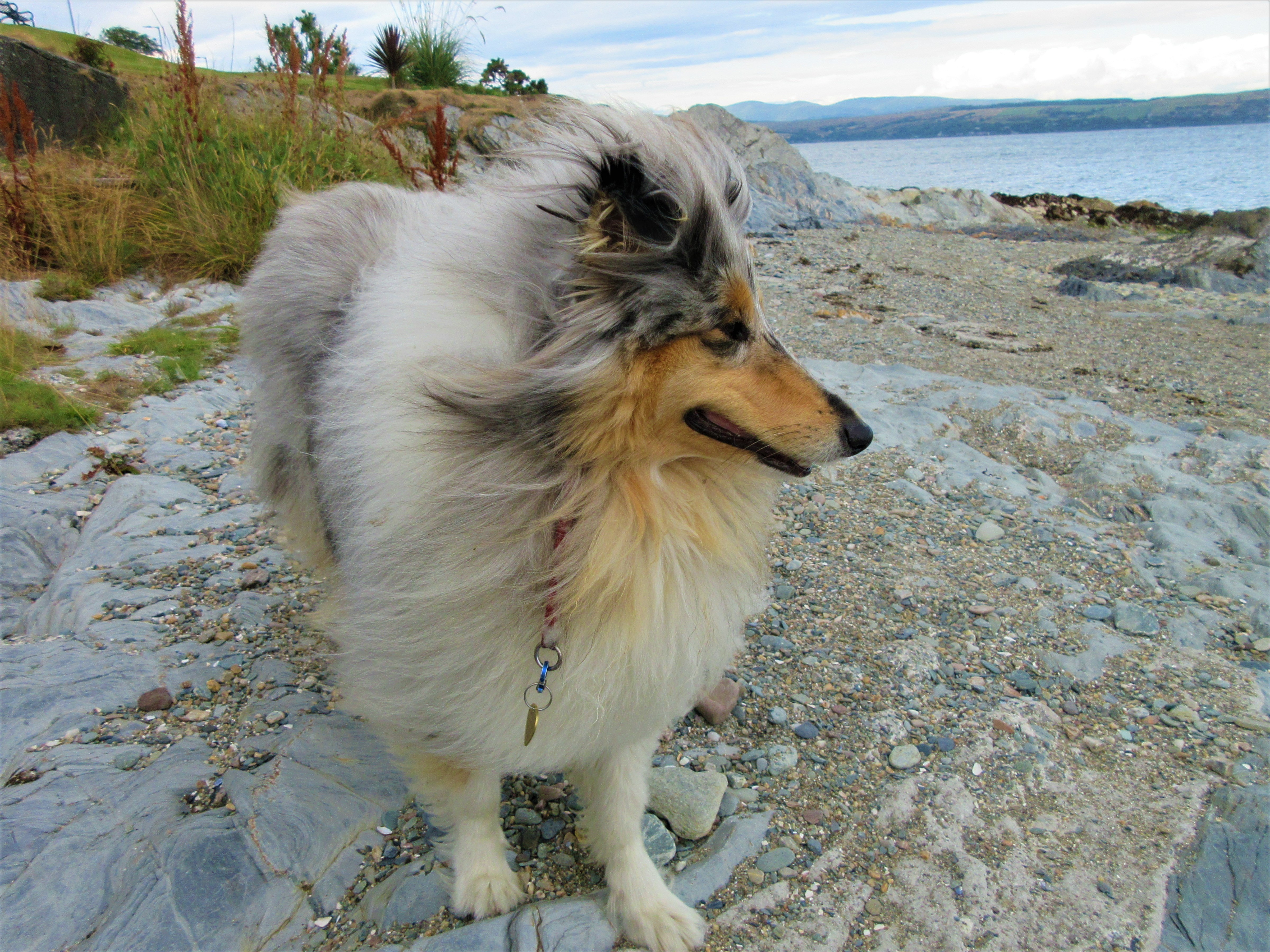
And then I spot two birds playing tug-of-war with a tuft of our collie’s hair to use to line their nests.
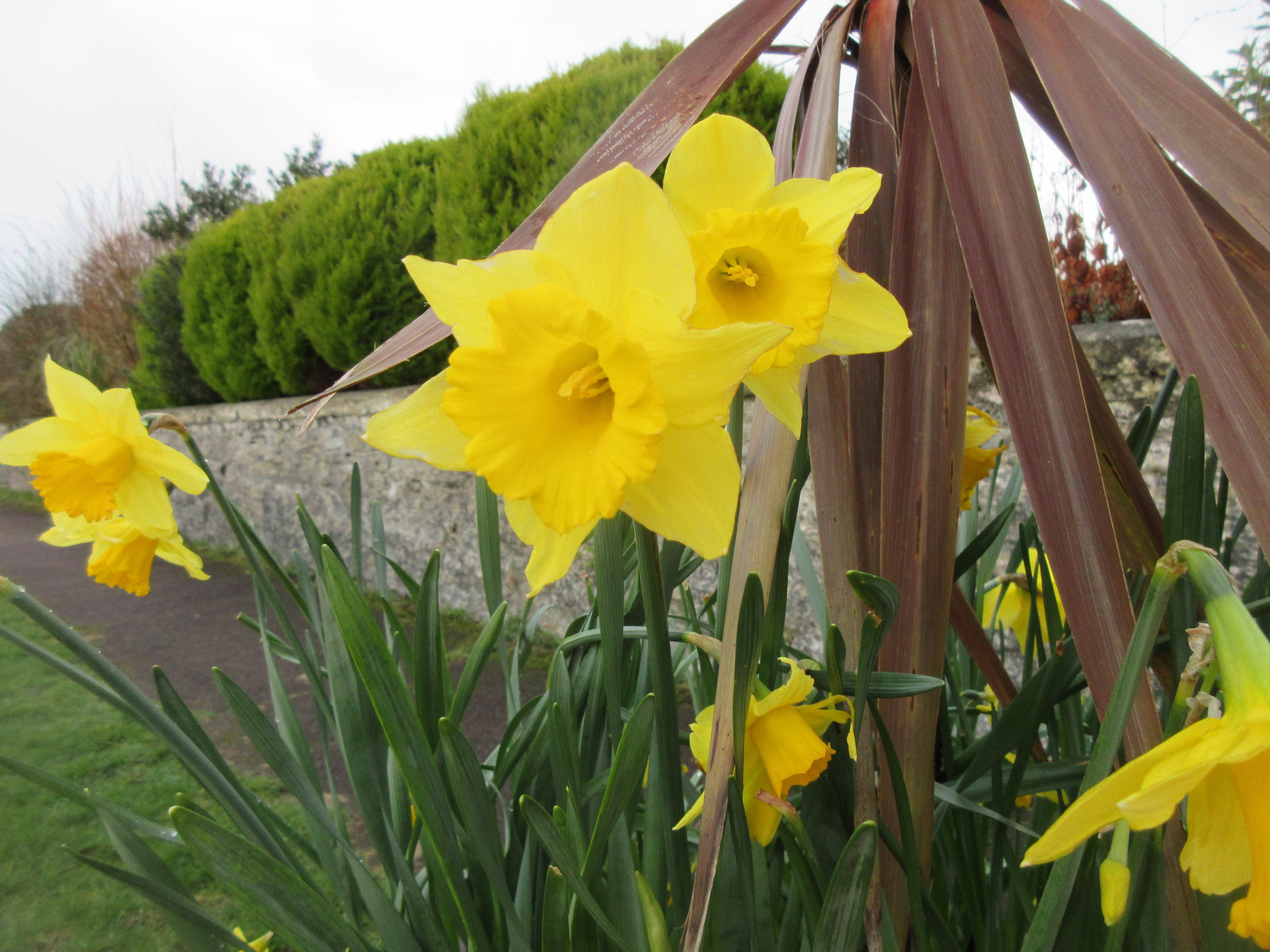
And then I see daffodils blazing their sunshine glory in front of a rock fence.
And then I notice buds creeping over the bare limbs of a tree.
And then I lose myself in wonder at the first traces of spring green unfurling in a new leaf.
And then I watch moms and dads walking their children past our house on the way to school.
And then I celebrate a splash of sunshine making it over the top of grey clouds.
And then I marvel in the hills rising behind us, the sea rolling at our feet, the friendly greeting of complete strangers along the path we both take, and the giggle of a baby testing grass with bare feet for the first time—and I remind myself that this is still God’s world.
“Finally, brethren, whatever things are true, whatever things are noble, whatever things are just, whatever things are pure, whatever things are lovely, whatever things are of good report, if there is any virtue and if there is anything praiseworthy—meditate on these things.” Philippians 4:8
It rains nearly every day in this part of Scotland. On the few days it doesn’t rain, it usually rains for at least part of every day. Dunoon averages nearly 70 inches of rain a year. In January this year, Dunoon saw a mere 37 hours of sun.
My heart is in the desert Southwest in the U.S. where rainfall averages between 12 and 13 inches annually with up to 320 days of sunshine. Yet, I have learned from inclement weather.
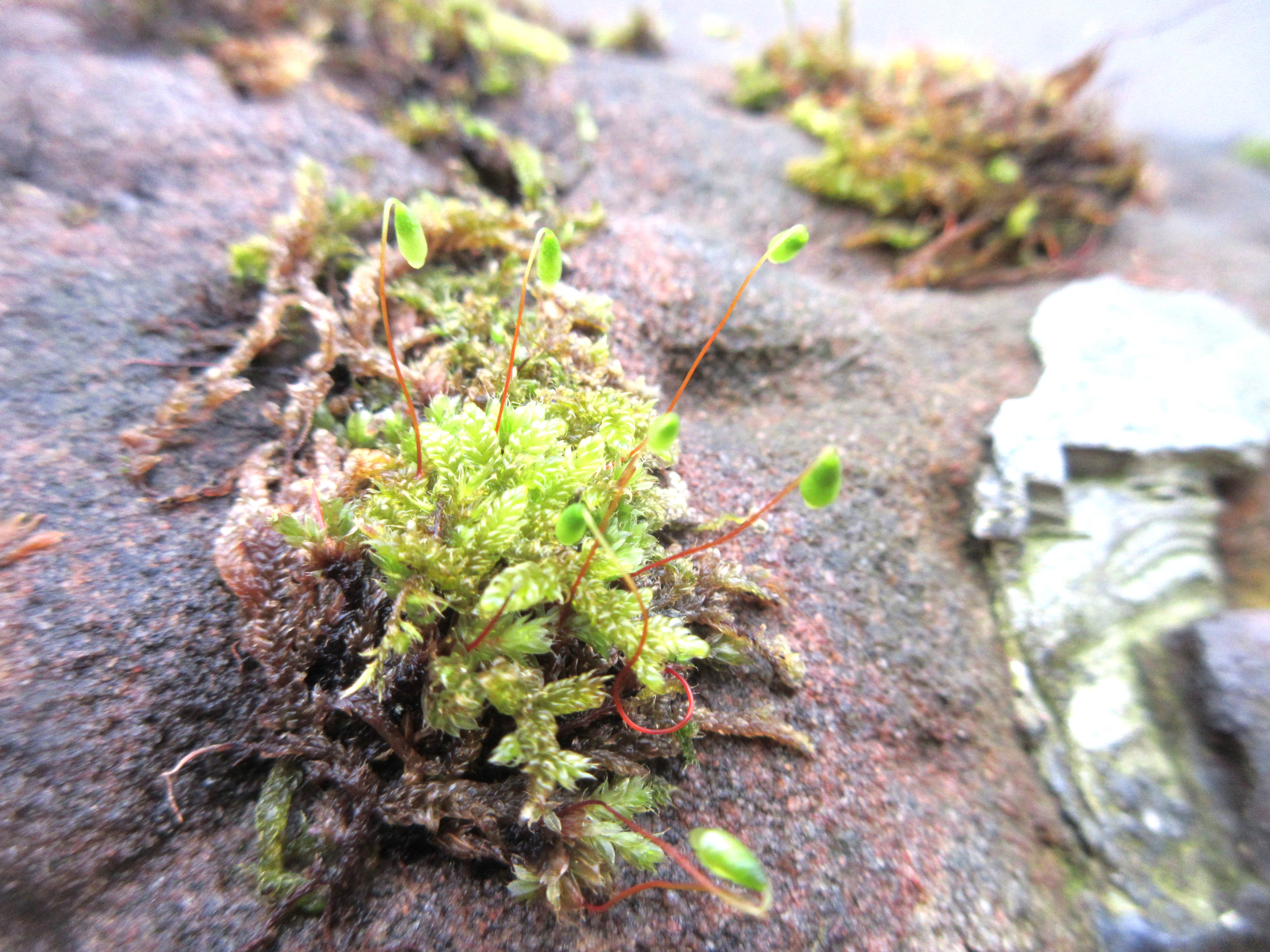
Moss blooms. Well, okay. According to the experts—it doesn’t bloom. It reproduces through spores. But it puts up shoots that look like blooms. I love to bend down and study moss intently when it “blooms.” I imagine a world invisible to us, peopled by tiny organisms that go about everyday life on their patch of moss tending the blooms that are like trees to them, building a secret life under our very eyes, a life that is impossible for us to see.
Because it is so wet here, moss grows on everything. I was amazed when we visited Rothesay on the Isle of Bute. Moss even grows on the wire fence around the castle.
When I had a hip replacement that became infected and was in the hospital for three months, I returned home to find our car encased in moss because it hadn’t been driven while I was gone.
Moss has also taught me that my elementary teachers were not infallible. They assured us that we could never get lost in the woods because moss grows on the north side of trees and we would always know which way was north. False. Wrong. It is so wet here in Scotland that moss grows all the way around tree trunks.
Inclement weather has taught me to preserve. With cold wind blowing blinding rainfall into my face and through every chink in my raingear—I don’t want to go on a walk. I don’t want to go outside the door of our little snug house. Yet, a dog needs a walk. Our dog doesn’t even have the benefit of a yard or garden. We have a two-foot strip of gravel around our house. So, out into the punishing, thrashing rain. It’s not comfortable, but it’s profitable because it strengthens me.
Inclement times in our lives are the same. We don’t enjoy them, but they grow us. They strengthen us.
“If indeed we suffer with Jesus, we may also be glorified together.” Romans 8:17.
There is a problem with writing cozy murder mysteries. It can make a folk downright suspicious of everything from hang-up phone calls to white vans.
The other day, walking through a store parking lot, I started past an empty white panel van. At least it looked empty from the side closest to me—but the radio was blaring. I stopped. Imagination went into overdrive. Why the radio in an empty van? Had the driver kidnapped someone? Was there a captive in the back and the radio blared to cover an attempt by that person to summon help?
I approached the van cautiously from the passenger’s side. It still looked empty. I crept around the back to the driver’s side and came face-to-face with a startled man so skinny that he practically bled into the dark leather driver’s seat. He was startled. He jumped in his seat. I was startled. I jumped—sort of. The problem with skinny folk is that they can move faster than the more fleshy folk—like me. He rolled down the window and demanded, “What do you want?”
I was so startled that I blurted out the truth. “I was just checking to make sure there wasn’t a kidnap victim in your van.”
Now he was even more startled. In an attempt to pass off my bizarre statement as a joke, I laughed. After a moment, he chuckled. Rather a weak uncertain chortle which told me that the only thing he believed about me was that—I was a crazy person.
But before y’all judge me, I have a history with white vans. When son Luke was seven, I was 20 feet up in the air repainting a billboard on the outskirts of Reno, Nevada. Luke was riding his bike around the desert lot below the sign when a white panel van pulled off the road and parked on the shoulder. Two men got out of the van and approached Luke, one of them holding a candy bar out in front of him. “Hey, sonny—look what I’ve got for you.”
I didn’t climb down from the sign. I dropped off the ladder like a stone, a growl building in my throat like a momma grizzly bear protecting her cubs. When I hit the ground, blue enamel flew out of the can and covered my arm and the front of my blouse. Before I could attack the men with the paint brush and can of paint—a stray dog that had shown up at our house the day before and adopted Luke charged the men. They saw a crazy blue-painted lady coming at them with a paint brush and a dog coming at them with teeth and flying fur. They vaulted back into their white van and took off with squealing tires.
When Luke was twelve, he started home on his dirt bike from his friend’s house a mile away. A white panel van came up behind his bike so closely that the bumper nearly hit Luke’s bike. Luke leaped the berm at the edge of pavement and rode into the desert to safety.
Fast forward to my job on a weekly newspaper in Lovelock, Nevada. I was assigned to cover the trial of human monsters Gerald and Charlene Gallego who hunted and captured young girls to rape, torture, and kill. They slaughtered at least ten young girls. They hit one pregnant girl in the head with a shovel and buried her in the desert while she was still alive. She was pregnant.
The couple traveled the Nevada desert in a white panel van with their victims and a shovel. Charlene drove while Gerald brutalized the girls in the back of the van. After Gallego killed them—he handed Charlene the shovel and told her to bury them. Sometimes they merely discarded their victims on the side of the road.
Because California courts were attempting to set the killer couple free, Pershing County, Nevada, tried Gallego in Lovelock and sentenced him to death for the two girls he killed and buried in Pershing County.
The point: don’t be quick to judge folks who seem eccentric, strange, or bizarre. They may have a reason for being weird. Or, they may be writers.
As with all things, the Bible sums it up best. When God directed the prophet Samuel to choose a king for Israel he said, “Do not look at his appearance, or at his physical stature…for the LORD does not see as a man sees; for man looks at the outward appearance, but the LORD looks at the heart.” 1 Samuel 16:7.
Meanwhile, for the foreseeable future—I’m avoiding white vans.
Here in our part of Scotland what we know as restrooms in the U.S. are sometimes labeled “WC” for “water closets.” Woe to the unsuspecting tourist who desperately needs a toilet and has no idea what the small “WC” sign on a building means.
Toilets in this part of Scotland are called “loos.” And the toilets are frequently labelled “male” and “female.” Humorous considering the fact that they clearly do not reproduce. Finding public toilets as you head north from here to the Black Isle is as difficult and frustrating as finding the end on a clear roll of tape.
Public toilets are so scarce that travelers must resort to extreme measures when they can’t hold it any longer. Or at least—I have. Leaning against the back of a vacant building. Hanging onto metal racks for support in the back of a closed store. Hiding behind the open door of the car on the side of the road. Not. Fun.
However, for folks like me—necessary. If I were not so adamantly opposed to drugs I could make a fortune peeing for drug tests.
And, when one can find a public toilet—dangers abound. The metal hardware has been painted over so many times that when one latches the door it’s a fight to get it open again. And, because the partitions stretch from floor to ceiling—there is no way to climb over or go under when the door won’t open again. On one road trip, it took two men and a handful of tools to extricate Alan from a toilet stall when he couldn’t open the door. The men had to unscrew and take the hinges off the other side to let him out.
Me? I’m so claustrophobic that I take my chances with not locking the door. If some desperate fellow traveler bustles in and plops down on my lap—I’ll just hope they have good aim.
And cold? Scotland never has what a Texan would consider a summer. When it gets over 70 degrees, folks complain that they are “broiling.” Many of the WCs along the way are not heated. Cold metal seats, cold carved granite seats—they are out there, folks!
Some bathrooms—even in a large hospital across the water still have big tanks of water hanging on the wall under the ceiling. A long tube runs down from the water tank to the toilet bowl. It flushes by pulling a chain with a wooden handle at the end.
Many of the more modern toilets have buttons on the top. The buttons are divided in half. The user is supposed to push the big part of the button to flush poo, and the smaller part for pees. The problem is that those buttons are hard to press down—especially for older folks. It is perplexing to me that the hospital across the water with the tanks on the wall would install push button toilets when so many of their patients lack the strength to push the buttons.
Perhaps it’s in poor taste to write a blog about toilets—but I don’t think so. God has marvelously created us. Our bodies are designed to take in and let out. We can’t survive if the process stalls.
Our bodies are not one member, but many members. “God has set the members, each one of them, in the body as He pleased… those members of the body which seem to be weaker are necessary.”1 Corinthians 12:22.
When I first arrived in Scotland from the U.S., I used to aggravate Alan by calling Scotland a “third world country.” But I’ve been stuck in one of those public toilets myself—with no one within hollering distance to help. Toilet dramas have found their way into several of my Miz Mike books and other books of mine which are set in Scotland.
A lot of folks give thanks for financial rewards, new vehicles, new clothes, vacations, trips abroad, dining at fine restaurants. I thank God for a wonky seatbelt.
When the seatbelt first malfunctioned—I was irritated. The tongue no longer stayed at the top where it belonged, but instead, dropped down to the floorboard. Since our car is so small, this means opening the door—almost always into blinding rain and punishing wind—to reach down and retrieve it. It’s difficult to be thankful for uncomfortable and awkward situations.
There are many things in my life for which I am thankful. The wonky seatbelt is a new addition.
My dream since childhood has been to write to write books. I have now written 49, and I am extremely thankful. Before my first book was published I was privileged to write for several different newspapers. I am extremely thankful for that. The situations I faced and the characters I met live again inside my 49 books.
I am thankful to have been born in Texas. I am thankful for the different states I have had an opportunity to reside in or visit: Georgia, Alabama, Nevada, California, Montana, Arizona, Florida. I am thankful for having been born in the United States, and now for my time in Scotland. Enrichment for my life. Fodder for my books.
God has blessed me with a marvelous family; marvelous memories; marvelous pets…and a marvelous life. I am thankful.
Not everything has been good. Not everything has been easy. I survived years of childhood sexual abuse and forced abortions that nearly killed me (performed by the perpetrator who had no medical knowledge or training but was determined to hide his crime). I survived an abusive, alcoholic spouse and divorce in my first marriage. I survived the cancer death of my second husband, and then an annulment from a conniving druggie who left me thousands of dollars in debt. A plane crash separated me from my wonderful son Luke. I have now spent several years as a care giver for my Scottish husband. Hard times, hard things.
Leaving my country was hard. Learning to drive on the wrong side of the road and use roundabouts; the difference in pronunciation of words like garage, aluminium, controversy, schedule, and dozens more—some of which still catch me by surprise. Different spellings. Flavour instead of flavor; programme instead of program; colour instead of color; tonne instead of ton; favourite instead of favorite.
Learning Scottish words like blether, braw, shoogily (shaky), haver (imagine), bairn (child), greet (to cry), stoor (dust or dirt), glaikit (fool or stupid) has been difficult, but these words figure richly in my books that are set in Scotland.
Learning that “tea” is the evening meal—or then again—it could just be tea. Learning that folks who ask to “clap” your dog do not intend abuse—they want to pet it.
I am thankful for all the things that have gone wrong in my life and all my unanswered prayers—which were actually answered. “No” is an answer.
It hurts to see my cancer, Parkinson’s Disease-stricken husband continue his slow decline. It’s hard. But I am thankful that I am here to take care of him.
And I am thankful for the wonky seatbelt.
When I get into the car and the seatbelt tongue is at the top where it belongs, I say, “Thank You, Jesus.” However, it is usually not in the proper position for fastening, so now I say, “Thank You, Jesus,” even when it is on the floorboard and I must fish for it.
And that is why I am so thankful for that wonky seatbelt. It reminds me on a daily basis to thank God. To thank God for the good, and to thank God for what does not appear to be good at the time.
My two favorite Bible verses are, “In everything give thanks for this is the will of God in Christ Jesus concerning you,” 1 Thessalonians 5:18, and “All things work together for good to those who love the Lord,” Romans 8:28.
Since childhood I have loved collies. One thing I love about them is their graceful, effortless trot.
I have been blessed enough in life to have been owned by several collies: Esther, Abby, Scot. All of them have exhibited that lovely gait that no other dog can emulate. And then there’s Savannah.
Savannah has owned us since puppyhood. She does not trot. She plods. She gallops. The trot is missing.
Because she is a blue merle—meaning her coat is black and grey—and because she plods, people mistake her for an old dog. She is seven. She has been mistaken for an old dog for years.
My writing resembles Savannah’s plodding. Thankfully I now have 49 books published, but, oh, those early years. I have a folder of rejection slips I’ve saved—150 of them. I don’t know how many I threw away before I started saving them. One east coast publisher wrote me a kind rejection letter for my children’s book, “Hubert the Friendless Snake.” I inundated him with children’s book manuscripts, none of which have ever been published.
I decided the solution was to get a literary agent. I got one. A crook. He took $150 for zero efforts and results and refused to return it. I desperately wanted to show up on his doorstep and demand a refund. But the logistics and travel expense of reaching North Carolina from Texas ultimately defeated that idea of revenge. I’ve since discarded that manuscript.
Then there was the publishing company that did accept one of my children’s book manuscripts. It held it for more than a year before deciding that the market had changed and they couldn’t use it. I still have it—several versions of it along with some beautiful illustrations an artist in Nevada did for me.
Enter the publishing company that accepted the first two of my Miz Mike cozy mystery-romance books. I wrote a total of eight books for that series. The publishing company promised to release them six months apart to build the momentum and keep it going. They published the first one. Two years later I was still waiting for the second release. It was released, but when the publishing company went bankrupt, I took back my rights to both books. I rewrote the books, hired an illustrator to do new covers, and changed to self-publishing. All the rest of the eight Miz Mike books were released quickly. I changed the title of the second Miz Mike to “Dead Body in a Pickup Truck,” which was what I wanted to call it from the start. The publishing company had deemed that title unsuitable. Dead Body in a Pickup Truck now has 23 ratings on Amazon with a 4.5 average. It is dedicated to my late son, Marine Corps Major Luke Parker, and includes the prophetic poem he wrote a year before his plane crash.
Plodding. I do my best to encourage other writers who want to give up. Plodding is difficult, both in writing and in dog walking. Take walking Savannah. When she plods in front of me, I have a tendency to run over her because she’s so slow. When she walks behind me, I need to stop frequently to let her catch up. And her gallop? It is so unexpected that she snatches the leash handle right out of my hand.
If you are reading this and you are a plodding writer, don’t give up. Even plodding writers experience explosions of success and joy.
Collies are my favorite breed of dog—even when they are missing gear. My favorite Psalm is Psalm 27. Verse 14 encourages, “Wait! On the LORD; be of good courage and He shall strengthen your heart. Wait, I say, on the LORD!”
God blessed me with an amazing and wonderful son, Luke, known by the Marine Corps as Major Luke Parker. Luke was everything in a son than any mother could ever imagine, yet, I always wanted more children.
I now have 49 kids. The second kid (book), “Dead Body in a Pickup Truck,” is dedicated to Luke and includes the prophetic poem he wrote a year before flying into the arms of Jesus when his plane fell out of the sky.
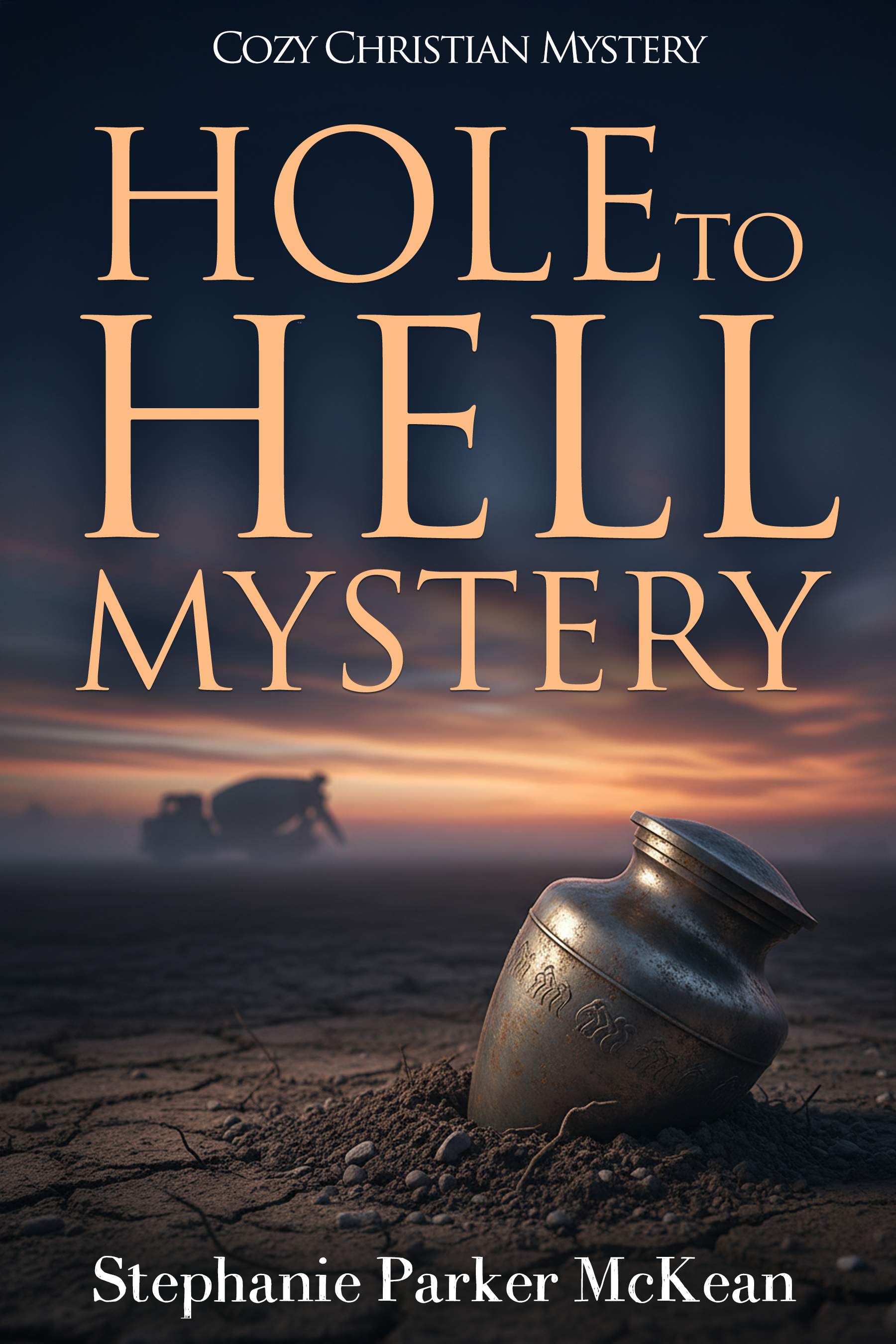
They can never replace Luke, but I am proud of all my kids. Still, I rarely dedicate a blog to them. “Hell to Hole Mystery” is different. For one thing, it uses the childhood sexual abuse that I suffered as background for the protagonist. For another thing—satan didn’t want this book published. I know that because problem after problem came against it, pushing the publication date ahead weeks at a time—a month in total by its publication today. If satan is against it—God is for it. There are only two gods in this world; the Lord God Who is all good and the Author of everything good, and satan who is all bad and the author of everything bad.
Like my other kids, “Hole to Hell Mystery” is a Christian cozy mystery. I would like to think that all my books are powerful and that readers leave the pages with more than what they brought into them. “Hole to Hell Mystery” is, however, more powerful and thought-provoking than my other cozy Christian mysteries. It is definitely different. My prayer is that it will enrich readers and bless them. That’s what I pray for all my kids, but even more for my newest one since God’s enemy fought so hard against its publication.
Thank you for loving my kids. May they always be welcome in your homes and lives. God bless.
I’ve had a blog written to share for a couple of weeks. Ironically, it is about all the hindrances that have come against the publication of my new book—which still has not been released. But, that’s okay—because Christmas should come first.
The Christmas Story, as told in Luke, Chapter 2, is matchless.
And it came to pass in those days that a decree went out from Caesar Augustus that all the world should be taxed. So all went to be taxed, everyone to his own city. Joseph went up from Galilee to Bethlehem with Mary, his betrothed wife, who was great with child.
So it was that while they were there the days were completed for her to be delivered and she bought forth her firstborn Son and wrapped Him in swaddling cloths and laid Him in a manger because there was no room for them in the inn.
Now there were in the same country shepherds living out in the fields keeping watch over their flock by night. And behold, an angel of the Lord stood before them, and the glory of the Lord shone around them, and they were greatly afraid.
Then the angel said to them, “Do not be afraid, for behold, I bring you good tidings of great joy which will be to all people. For there is born to you this day in the city of David a Savior who is Christ the Lord. And this will be a sign to you, you shall find a Babe wrapped in swaddling cloths lying in a manger.”
And suddenly there was with the angel a multitude of the heavenly host praising God and saying, “Glory to God in the highest, and on earth peace, goodwill toward men!”
And no book, no blog, no surfeit of words that I can write could compete with that beautiful story. God came down to earth so we can go to heaven.
Growing up in rural Georgia in the 1960s, folks were too poor for a lot of things. I daresay that if any of us had seen a raincoat on a dog—we would have laughed. Where we lived, people could not afford raincoats even for themselves.
Many pet owners never took their animals to the vet. They couldn’t afford that either. Our 4-H Club sponsored a rabies clinic once a year so folks could get their animals vaccinated. For a lot of dogs it was the only time in their lives that they saw a vet.
It probably stems from the “Lassie” TV series we watched as kids, but I have a lifelong love for collies. As a child, the closest I ever came to owning a collie was a neighbor’s black and white border collie that kept following me home until the owners finally let me keep it.
Then there was Prince, a part-collie stray dog that showed up at our house and stayed. He saved my life when the Hester’s horned cow cornered me against the side of the barn and charged. Prince leaped between us with ferocious growls and frenzied barking and bit the cow on her nose.
Along with “Kicker,” the killer cow, the Hesters were given a gorgeous tri-colored collie. I was jealous. I had wanted a collie dog like “Big Boy” for as long as I could remember. Somehow, Big Boy got hit by a car. He survived, but with a limping gait and an ugly cut across the end of his nose. Big Boy wasn’t my dog, but I loved him. He was a collie. I knew he needed veterinary attention, but the Hesters didn’t have money for that. In fact, in all the years I knew them none of the Hesters went to a doctor either. Their solution for injured animals was to spit tobacco juice on the wound or cover it with purple horse liniment. I begged my parents to let me take Big Boy to the vet since the Hesters couldn’t afford it. But my parents couldn’t afford it either.
People wearing ruined blue jeans that they purchased that way new confounds me. In my 1960s rural Georgia, we wore jeans like that because we couldn’t afford anything else. We wore our clothes until the holes would no longer hold a patch. I often went to school wearing tennis shoes that were held together with the thick rubber bands off the Sunday newspaper. It wasn’t “cool” or fashionable to wear jeans with holes in them—we were embarrassed—but we wore them anyway because it was all we could afford.
How times change. Nowadays, folks choose to wear ruined clothes—and pay big bucks for them—and dogs wear raincoats.
It is comforting to know that not everything changes. “For I am the LORD, I do not change.” Malachi 3:6.
A lot of folks complain about Facebook. I never have. It’s free. Why should I complain about something when I’m not contributing to it?
I don’t know when it changed, because with writing new books and taking care of a husband who has blood cancer, Parkinson’s, and vascular dementia and is unable to weight-bear—plus walking a dog since we have no yard—I stay rather occupied. Sometimes it takes me several days to find enough free time to cut my fingernails.
The point is that I suddenly noticed that Facebook had changed my profile from author to “digital creator.” Now that is funny. Computers are as much of a mystery to me as math. What I know about computers is how to turn them on—and even that is iffy if it isn’t my computer—write a book, save it, and email it to my editor. I can even download the cover the illustrator sends me and send it to the editor. That’s all. I only visit internet sites if I am researching for a book. I don’t download anything on my 15-year-old laptop computer—which is running out of memory—and I don’t have a mobile phone, “smart,” or otherwise.
When I noticed the FB shift, I decided to rectify it immediately. Back to why it was so funny to designate me as a digital creator. I didn’t know how to change the change. Before I knew it, FB had changed it itself. It decided I was a government agency. With everything that is going on in the world at the moment, that’s not funny—it’s scary.
Changing it again was no easier than the first time because the computer program running Meta had no category for author. Authors must be an endangered species.
Now I finally have a working profile that fits me better—writer. I’ve dreamed of being an author all my life—at least from the time I was eight—so it seems a bit disappointing to settle for “writer” rather than “author”—but at least I’m not looking over my shoulder because I’m listed as a government agency—so I will return to not complaining about FB in spite of the seemingly random and unnecessary changes it makes constantly.
I have a new book coming out in a few weeks. A powerful, hard-hitting mystery that does not ignore the correlation between child abuse and crime. My FB label—writer or author—really doesn’t matter just so readers buy the book.
Labels change. People change their ideas about labels. One thing never changes. God. People give Him many labels, but He is the Lord God, Creator of the universe.
“He knows the way that I take; When He has tested me, I shall come forth as gold. He is unique, and who can make Him change?” Job 23:10 & 13.
No matter what label anyone or anything attaches to me, it can’t change what God created when He made me and called me to write books.




 Stephanie Parker McKean